
How to Follow Up With Real Estate Leads: A 30-Day Plan That Gets Replies

Contact a new buyer lead within the hour, then follow a simple cadence: a call and text on day 0, a value text on day 1, a call on day 3, a short email on day 7, then weekly touches through day 30. Every message after the first should give the buyer something useful, usually homes that match what they asked for, rather than “just checking in.”
Most buyer leads don't go cold because the agent said the wrong thing. They go cold because the agent stopped saying anything. A lead who filled out a form on a Saturday might not be ready until spring, and the agent who is still sending them useful homes in March is the one who gets the call.
This guide gives you a concrete, day-by-day plan for the first 30 days with a new buyer lead, the messages to send at each step, and how to make most of it run on autopilot so you can keep doing it when business picks up.
Why most real estate follow-up fails
Follow-up breaks down for three predictable reasons:
- It's slow. Research published in Harvard Business Review found that firms contacting a web lead within an hour were about seven times more likely to have a meaningful conversation than those who waited even one more hour. Read more in our guide to speed to lead.
- It stops too early. Agents send two or three messages, hear nothing and move on, even though plenty of buyers are months away from touring.
- It's empty. "Just checking in!" gives the buyer nothing to respond to. A specific home that fits their budget does.
The plan below fixes all three: it starts fast, it runs for a full month before shifting into long-term nurture, and every touch carries something of value.
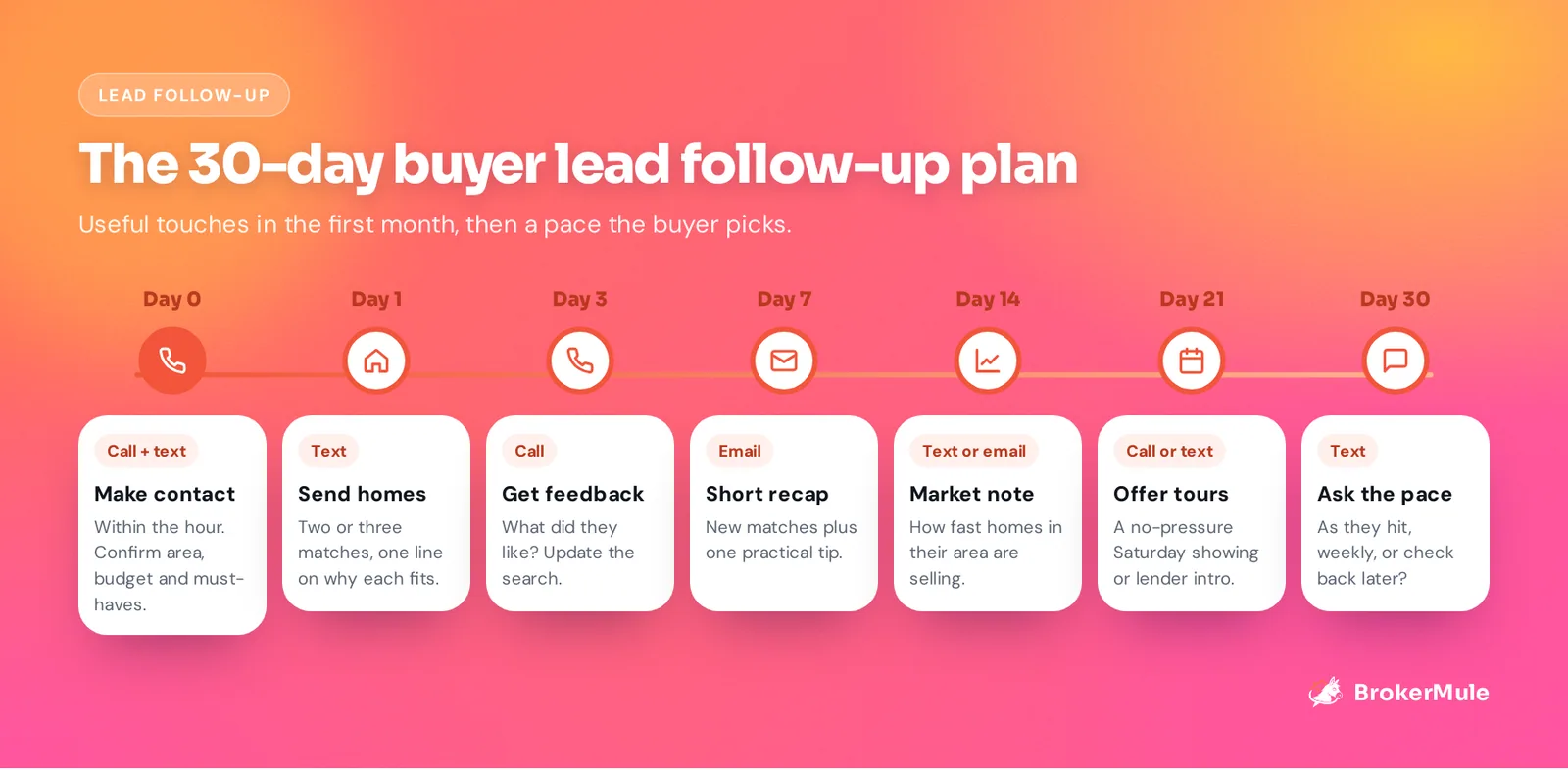
The 30-day follow-up plan at a glance
| Day | Channel | What to send |
|---|---|---|
| 0 (first hour) | Call, then text | Introduce yourself, confirm what they're looking for |
| 1 | Text | Two or three homes that match their search |
| 3 | Call | Ask what they liked or didn't about the homes |
| 7 | A short note with new matches and one useful tip | |
| 10 | Text | A new listing worth a look |
| 14 | Text or email | A quick read on their target area (prices, how fast homes are selling) |
| 21 | Call or text | Offer a no-pressure tour or a lender intro |
| 30 | Text | Ask how they'd like to hear from you going forward |
Day 0: the first hour
Call first. If they don't answer, leave a short voicemail and follow it with a text right away, because many buyers won't pick up an unknown number but will read a text.
Your only goals on day 0 are to make contact and learn enough to send good homes: area, price range, beds and baths, and anything they can't live without. Write it down on their client record the moment you hang up. If you're using BrokerMule, that's the Add client form, and the "Must-haves / Wants" box is where those details go.
Before you add anyone to automated texts, get their permission. Our real estate SMS compliance guide covers what consent looks like in practice.
Day 1: send homes, not questions
The best second message is useful on its own. Send two or three homes that fit what they told you, each with one sentence on why you picked it.
That last question matters. A "yes" gives you permission to keep sending and tells you this lead is engaged.
Day 3: the feedback call
Call to ask what they thought of the homes. You'll learn more from "the kitchen in the second one was too small" than from any form. Update their search with what you learn, and note it on their record so you don't ask twice.
Day 7: the email touch
Some buyers prefer email, and a weekly email gives them something to come back to. Keep it short: a few new matches, one practical tip (for example, how to get pre-approved), and your contact details. If you send these regularly, a template saves time. See real estate drip campaign examples for a full sequence.
Days 10 to 21: stay useful
From here, the rhythm is roughly weekly, and the content is mostly new homes. Mix in:
- A quick market note on day 14: how fast homes in their area are going under contract, or a recent sale near their price.
- A soft invitation on day 21: "If any of these are worth seeing in person, I can set up a few showings on Saturday." Turn requests into a planned route using our showing tour guide.
Watch for buying signals, like replies within minutes, questions about a specific address or asking about lenders. When you see them, pick up the phone.
Day 30: ask how they want to hear from you
After a month, ask directly:
Their answer tells you whether they move to active touring, a weekly cadence, or long-term lead nurturing. Our article on how often a realtor should text a buyer goes deeper on picking the right frequency.
Automate the useful part
The hardest part of this plan isn't the first call. It's sending fresh, relevant homes every week to every lead without spending your mornings on portal searches.
That's the part worth automating. In BrokerMule, each buyer's search runs every weekday (or once a week), and the AI writes a personal text about the best new match in your voice, signed with your name. When a buyer replies SAVE or TOUR, it shows up on your dashboard. See exactly how it works in how AI listing texts work.
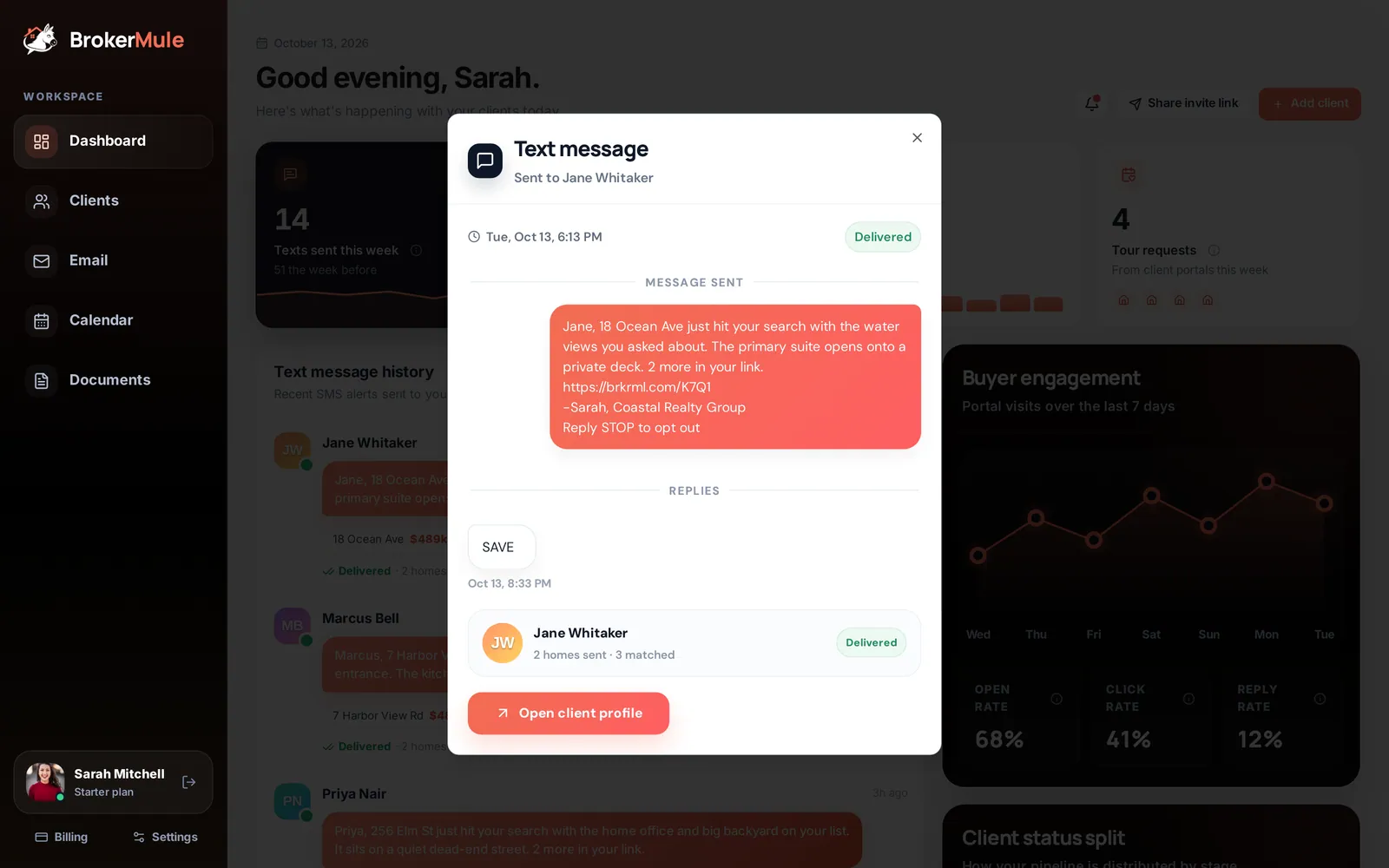
That leaves the human parts for you: the day 0 call, the feedback conversations, the tour invitations. Replies and portal chat land on the client's page, so the whole conversation stays in one place.
Track every lead in one place
A follow-up plan only works if you can see where each lead is. At minimum, track:
- When you last contacted them, and how
- What they're looking for, in their own words
- Homes they liked, saved or rejected
- The next step and its date
A spreadsheet can do this for five leads. At twenty, things slip. Read real estate CRM vs spreadsheet for where the line usually is, and real estate pipeline stages for a simple way to organize buyers by where they are.
Common follow-up mistakes
- Waiting until Monday. Weekend leads are often the most motivated. Respond the same day.
- Asking without giving. Every message should include a home, an answer or a useful fact.
- Sending the same message to everyone. Mention their street, their must-have or their budget.
- Giving up at three touches. A lead who hasn't replied in two weeks hasn't said no.
- Never asking about frequency. Buyers who feel spammed opt out. Buyers who chose the frequency stay.
Do it in BrokerMule
All guidesAI listing textsWhat happens behind every automated text: the daily search, how the AI writes in your voice, reply keywords, opt-outs and where to see results.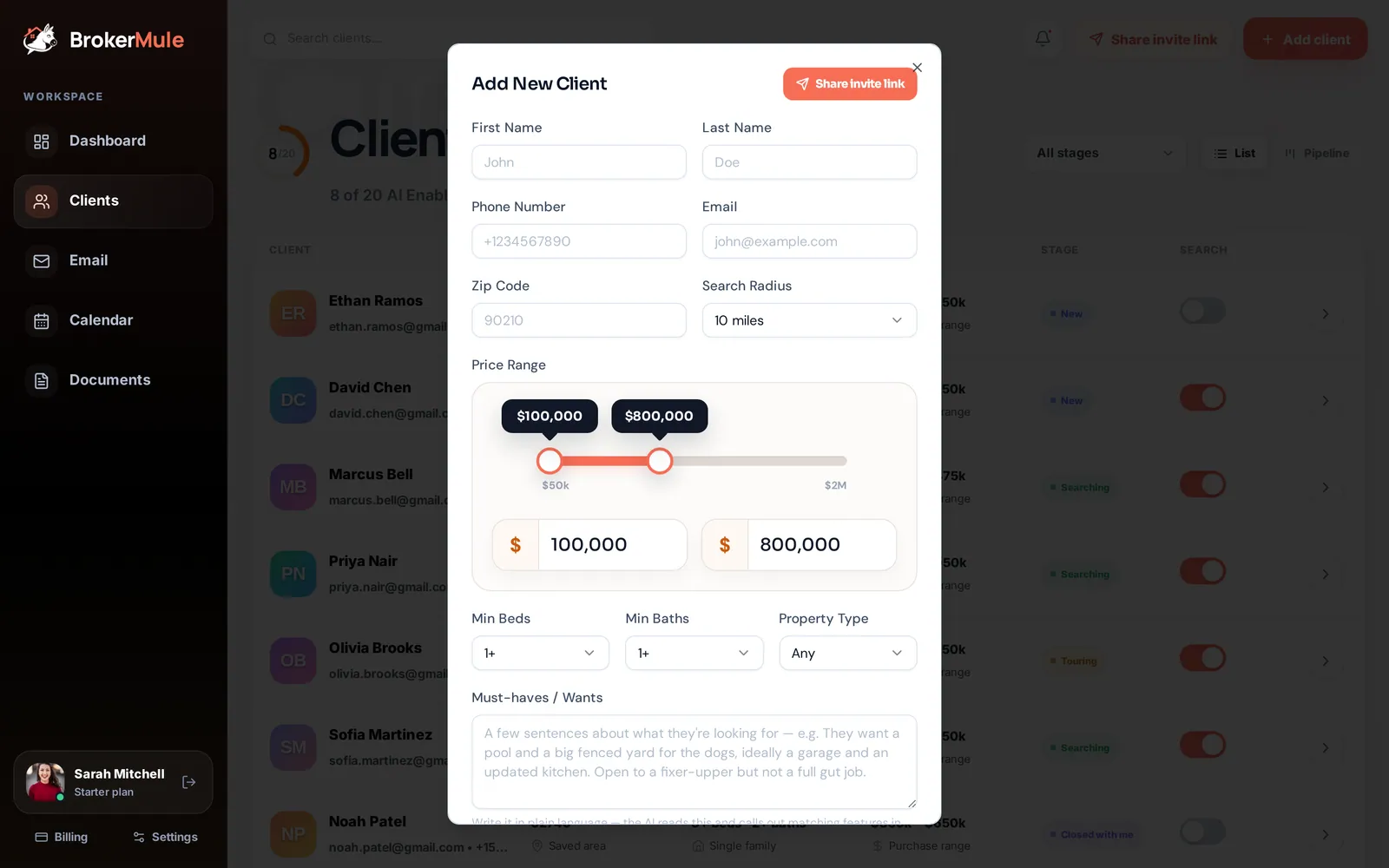 Adding clientsEvery field on the Add client form, what the AI does with it, and how to activate texting with the right consent.
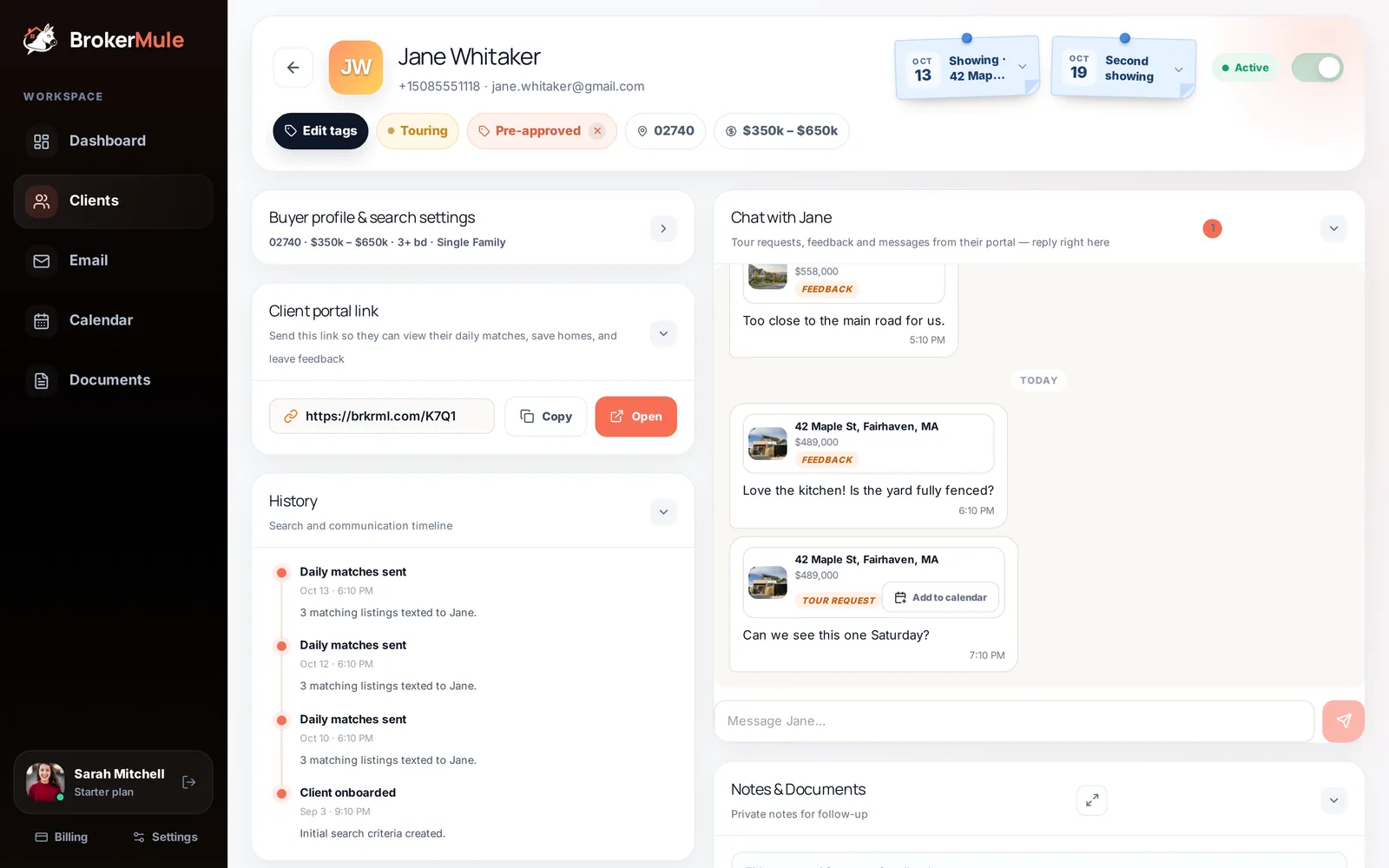 The client pageA tour of every section on a buyer’s page, from live chat and private notes to saved homes, tour requests and the full text history.
Frequently asked questions
How many times should you follow up with a real estate lead?
Plan on 8 to 10 touches in the first 30 days, then move to a weekly or monthly rhythm based on how ready the buyer is. Keep going until they buy, ask you to stop or tell you they are working with someone else.
How quickly should I respond to a new buyer lead?
Within the first hour if you can, and within five minutes if the lead came from a form they just filled out. Response rates drop sharply after the first hour.
Is it better to call or text a new lead?
Do both. Call first, because a conversation tells you the most. If they do not answer, text right away so they have your name and a reason to reply.
What should I say when following up with a lead who went quiet?
Send something specific and useful rather than a check-in, such as a new listing that matches what they asked for, then ask a simple yes-or-no question like “Want me to keep sending ones like this?”
Can I automate real estate lead follow-up?
Yes. The repetitive part, sending fresh matching homes on a schedule, is easy to automate. Keep calls, feedback conversations and tour planning personal.
Sources
Competitor pricing and features change often. These were the references used when this page was last reviewed — verify anything critical before making a purchase decision.
Keep reading
 Lead follow-upSpeed to Lead in Real Estate: Why the First Hour Decides Who Wins the Buyer
What the research says about lead response time, and how a solo agent can answer every lead within minutes.
 Lead follow-upReal Estate Lead Nurturing: How to Stay Top of Mind With Buyers Who Aren’t Ready Yet
A simple system for buyers who are months away: what to send at each stage and how to spot when they’re ready.
 CRM & texting30 Real Estate Text Message Templates That Sound Like a Real Person
30 copy-and-paste real estate text templates for new leads, active buyers, listing matches, showings, re-engagement and past clients — plus how to make them not sound templated.